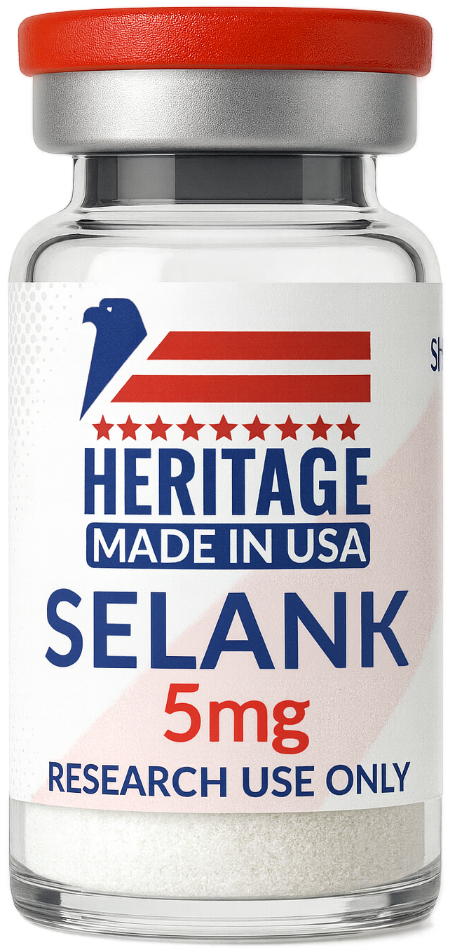
What is Selank?
Selank is a seven-amino-acid synthetic peptide built on tuftsin, a natural immune-modulating peptide in your body. Russian scientists at the Institute of Molecular Genetics added a Pro-Gly-Pro tail that dramatically extends its stability and half-life. Russia approved it in 2009 as a nasal spray for generalized anxiety and cognitive enhancement.
The anxiolytic mechanism of Selank involves modulation of the GABAergic system and monoamine neurotransmitter pathways. Research has shown that Selank increases BDNF (brain-derived neurotrophic factor) expression in the hippocampus, modulates the balance of T-helper 1 and T-helper 2 cytokines, influences serotonin metabolism by affecting tryptophan hydroxylase expression, and stabilizes enkephalin levels in the blood [2]. Unlike benzos, Selank doesn't sedate you, fog your thinking, or create dependence. That's a huge differentiator.
On the cognitive side, animal studies show Selank improves learning and memory — especially when stress would normally impair those functions. Gene expression studies reveal that Selank affects the expression of 36 genes in the hippocampus, many related to neuronal plasticity, signal transduction, and neurotransmitter regulation [3]. The compound also exhibits significant immunomodulatory activity, influencing IL-6, TNF-alpha, and interferon expression, reflecting its tuftsin-derived heritage.
Mechanism of Action
Selank's anxiolytic and nootropic effects arise from a multifaceted interaction with several neurochemical systems, distinct from conventional anxiolytics:
GABAergic Modulation
Selank modulates the GABAergic system without directly binding to GABA-A receptors in the manner of benzodiazepines. Instead, it influences GABA metabolism and receptor sensitivity, producing anxiolytic effects without the sedation, tolerance, or withdrawal associated with direct GABA-A agonists. This mechanism makes Selank functionally anxiolytic while preserving alertness and cognitive function [1].
BDNF & Neuroplasticity
Selank upregulates BDNF expression in the hippocampus and prefrontal cortex. BDNF is a key mediator of synaptic plasticity, long-term potentiation, and neuronal survival. Increased BDNF levels are associated with improved learning, memory consolidation, and resilience to stress-induced neuronal damage. This mechanism likely underlies Selank's nootropic properties [3].
Serotonin & Enkephalin Systems
Research demonstrates that Selank influences serotonin metabolism through modulation of tryptophan hydroxylase expression, the rate-limiting enzyme in serotonin synthesis. Additionally, Selank stabilizes enkephalin levels in the blood, preventing their rapid enzymatic degradation. Enkephalins are endogenous opioid peptides involved in mood regulation and stress adaptation. This dual action on serotonergic and opioidergic systems contributes to the compound's anxiolytic profile.
Immunomodulatory Activity
Reflecting its tuftsin heritage, Selank modulates immune function through effects on cytokine expression. It has been shown to influence the balance of pro-inflammatory (Th1) and anti-inflammatory (Th2) cytokines, normalize IL-6 and TNF-alpha levels, and enhance antiviral interferon expression [4]. These immunomodulatory effects operate independently of the anxiolytic mechanism and may contribute to improved well-being during periods of psychological stress.
Dosing Protocol
Selank can be administered intranasally or subcutaneously. The intranasal route is most commonly used in approved Russian clinical practice and provides rapid absorption through the nasal mucosa.
| Protocol | Dose | Frequency | Duration | Notes |
|---|---|---|---|---|
| Intranasal (standard) | 250–500 mcg | 2–3x daily | 14–21 days | Most common research route; rapid absorption |
| Subcutaneous | 250–500 mcg | Once daily | 14–21 days | Higher bioavailability than intranasal |
| Low-dose anxiolytic | 250 mcg | 2x daily (intranasal) | 14 days | Conservative starting protocol |
| Nootropic focus | 500 mcg | 2–3x daily (intranasal) | 21 days | Higher dose for cognitive enhancement |
- Allow equal or longer rest periods between cycles (e.g., 14 days on, 14+ days off).
- For intranasal administration, clear nasal passages before application. Tilt the head slightly forward.
- Subcutaneous dosing provides higher systemic bioavailability but is less convenient for multiple daily doses.
- No dependency or tolerance development has been reported, but cycling is recommended as standard practice.
Reconstitution Guide
Reconstitute the Selank with bacteriostatic water. The Pro-Gly-Pro extension provides better stability than native tuftsin. For intranasal use, the reconstituted solution is transferred to a nasal spray device.
- Remove the plastic cap from the Selank vial and wipe the rubber stopper with an alcohol swab. Allow to dry.
- Draw
2 mLof bacteriostatic water into a sterile syringe. For a 5 mg vial, this yields a concentration of2,500 mcg/mL. - Insert the needle through the rubber stopper at a slight angle. Inject the water slowly against the inner wall of the vial — do not spray directly onto the peptide powder.
- Allow the vial to sit for 1–2 minutes. Gently roll the vial between your palms if needed. Do not shake or vortex.
- The solution should be completely clear and colorless. Discard if you observe any cloudiness, particulate matter, or discoloration.
5 mg vial + 2 mL BAC water: Concentration = 2,500 mcg/mL
250 mcg dose = 10 units (0.1 mL) on a 100-unit insulin syringe
500 mcg dose = 20 units (0.2 mL) on a 100-unit insulin syringe
Doses per vial: 20 doses at 250 mcg, or 10 doses at 500 mcg
- 2 vials Selank (5 mg each) — provides 40 doses at 250 mcg, covers 28 doses with margin
- 1 vial bacteriostatic water (30 mL)
- 1 sterile nasal spray bottle (for intranasal use) or 28 insulin syringes (for SubQ)
- Alcohol prep pads
Injection Technique
Selank can be administered subcutaneously (SubQ) or intranasally. For SubQ injection, follow standard peptide injection technique.
- Clean the injection site with an alcohol swab and allow it to air dry completely (approximately 30 seconds). Common sites: lower abdomen (2 inches from the navel), upper thigh, or upper outer arm.
- Draw the dose. Insert the needle into the vial through the rubber stopper. Invert the vial and draw the calculated number of units slowly. Tap the syringe to move any air bubbles to the top, then push them out gently.
- Pinch the skin at the injection site to create a fold of subcutaneous tissue. Insert the needle at a 45- to 90-degree angle in a quick, smooth motion. Release the skin fold.
- Inject slowly. Depress the plunger steadily over 5–10 seconds. Withdraw the needle at the same angle it was inserted. Apply gentle pressure with a clean swab if needed.
For intranasal use, transfer reconstituted Selank to a sterile nasal spray bottle. Each spray delivers approximately 0.1 mL. Administer 1–2 sprays per nostril per dose. Clear nasal passages before use. Tilt head slightly forward, insert tip into nostril, and spray while inhaling gently. Avoid blowing nose for 5 minutes after administration.
Storage & Stability
Selank benefits from its Pro-Gly-Pro extension, which provides better enzymatic stability than native tuftsin. Proper storage practices remain essential.
- Store vials upright, out of direct light.
- If using a nasal spray bottle, keep refrigerated between uses and discard after 21 days.
- Never re-freeze a reconstituted vial. If it sat out at room temp for more than 4 hours, toss it.
- Pro tip: write the reconstitution date on the vial so you know when the 21-day window expires.
Side Effects & Considerations
Selank has been well-tolerated in Russian clinical use since its approval in 2009, with a safety profile that compares favorably to benzodiazepines and SSRIs.
Commonly Reported
- Mild nasal irritation — with intranasal administration; transient stinging or dryness. Usually resolves within minutes.
- Mild fatigue — reported in some individuals at higher doses, particularly during the first few days of use.
- Slight changes in appetite — both increase and decrease have been reported anecdotally.
Theoretical Considerations
- No sedation, cognitive impairment, or withdrawal effects have been documented — a significant advantage over benzodiazepine anxiolytics.
- No dependency or tolerance development reported in clinical or preclinical studies.
- Immunomodulatory effects may not be desired in all research contexts; individuals with autoimmune conditions should exercise caution.
- Clinical data is predominantly from Russian researchers; independent Western replication is limited but growing.
Selank is approved in Russia but is classified as a research peptide in most other jurisdictions. It's not FDA-approved for any clinical use. Everything here is from published research — it's not medical advice.
Stacking Protocols
Selank is frequently studied alongside other nootropic peptides, particularly Semax. The two compounds have complementary mechanisms and are often combined in research protocols.
Selank + Semax (Nootropic Stack)
The most common nootropic peptide combination. Selank provides anxiolytic and mood-stabilizing effects while Semax delivers cognitive enhancement and neuroprotection. The two peptides share the same Pro-Gly-Pro stabilizing extension but act through different receptor systems.
| Peptide | Dose | Frequency | Duration |
|---|---|---|---|
| Selank | 250–500 mcg | 2x daily (intranasal) | 14–21 days |
| Semax | 200–600 mcg | 2–3x daily (intranasal) | 10–21 days |
Lifestyle Factors
Research suggests the following complementary practices may support Selank's anxiolytic and cognitive effects:
- Mindfulness and stress reduction: Selank's anxiolytic effects may be enhanced by concurrent stress management practices including meditation, deep breathing, and regular exercise.
- Sleep quality: Adequate sleep supports BDNF production and memory consolidation, complementing Selank's neuroplasticity-enhancing effects.
- Omega-3 fatty acids: DHA and EPA support neuronal membrane fluidity and BDNF signaling, potentially enhancing nootropic benefits.
- Cognitive training: Combining Selank with structured learning or cognitive exercises may maximize the neuroplasticity window created by increased BDNF expression.
Selank is available in 5 mg vials from Heritage Labs USA, a U.S.-based research peptide supplier with batch-level purity verification.
- Third-party purity testing (HPLC & MS)
- U.S.-based fulfillment
- Published COAs per lot
Literature & Citations
- Zozulya AA, Gabaeva MV, Sokolov OY, et al. Personality, coping style, and constitutional neuroimmunology. J Immunotoxicol. 2008;5(2):221-225. PubMed
- Kozlovskii II, Danchev ND. The optimizing action of the synthetic peptide Selank on a conditioned active avoidance reflex in rats. Neurosci Behav Physiol. 2003;33(7):639-643. PubMed
- Semenova TP, Kozlovskaya MM, Zuikov AV, et al. Effect of Selank on cognitive processes after damage to the catecholaminergic system of the brain in rats. Bull Exp Biol Med. 2007;144(5):689-691. PubMed
- Ershov FI, Uchakin PN, Ershova ON, et al. Antiviral activity of immunomodulator Selank in experimental influenza infection. Bull Exp Biol Med. 2009;148(9):744-748. PubMed
- Kozlov SV, Mezentseva MV, Zhurilo NI. Selank and its analogs: effects on gene expression in the hippocampus. Bull Exp Biol Med. 2010;150(1):70-72. PubMed
- Seredenin SB, Kozlovskaya MM, Blednov YuA, et al. The anxiolytic action of an analog of the endogenous peptide tuftsin on behavior in rats in the Vogel conflict test and elevated plus-maze. Zh Vyssh Nerv Deiat Im I P Pavlova. 1998;48(1):153-160. PubMed
- Kost NV, Sokolov OY, Gabaeva MV, et al. Serum endogenous opioids and the effect of the anxiolytic selank on the enzymatic degradation of Leu-enkephalin. Bull Exp Biol Med. 2001;132(3):898-901. PubMed