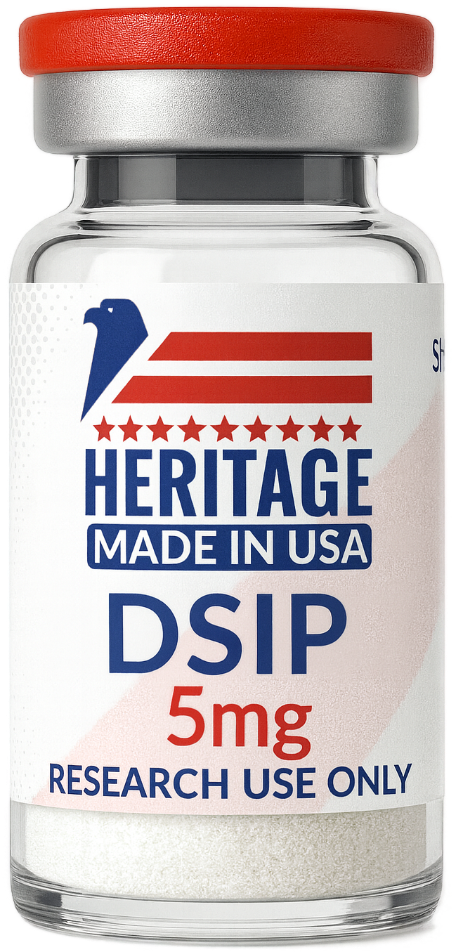
What is DSIP?
DSIP (Delta Sleep-Inducing Peptide) is a nine-amino-acid peptide that your body naturally produces. Swiss researchers Schoenenberger and Monnier first found it in 1977 — they isolated it from rabbit brain blood during electrically triggered sleep [1]. When they gave it to other animals, it promoted delta-wave sleep — the deepest, most restorative phase of the sleep cycle.
DSIP's mechanism is genuinely complex and still not fully mapped out. Unlike most drugs that hit one receptor, it works across multiple brain systems simultaneously. Research has identified several mechanisms: modulation of GABAergic signaling, interaction with opioid receptor systems, regulation of corticotropin-releasing hormone (CRH) and ACTH secretion, and influence on serotonin and norepinephrine turnover [2]. It also functions as a stress buffer, dialing down cortisol and ACTH responses while helping reset disrupted sleep patterns.
Human studies tell an encouraging story: DSIP can fix disrupted sleep patterns without the grogginess, brain fog, or addiction risk that come with benzos and sleeping pills [3]. People with chronic insomnia fell asleep faster, slept better, and spent more time in deep restorative sleep. Beyond sleep, DSIP has also been researched for chronic pain, alcohol and opioid withdrawal, and stress-related hormonal disruption.
Mechanism of Action
What makes DSIP different from a sleeping pill? It doesn't just push one button. It works across several brain chemistry systems at once:
GABAergic & Glutamatergic Modulation
DSIP modulates the balance between excitatory (glutamatergic) and inhibitory (GABAergic) neurotransmission in the brain. Unlike benzodiazepines which directly enhance GABA-A receptor function, DSIP appears to work upstream by influencing GABA synthesis and release patterns, promoting a physiological shift toward sleep-favorable neurochemistry without suppressing normal neural activity [4].
HPA Axis Regulation
DSIP acts as a stress-limiting factor by modulating the hypothalamic-pituitary-adrenal (HPA) axis. It reduces the magnitude of cortisol and ACTH responses to stress, effectively dampening the neuroendocrine stress cascade that interferes with sleep onset and maintenance. This mechanism is particularly relevant for stress-related insomnia, where elevated evening cortisol prevents the natural transition to sleep [2].
Opioid System Interaction
Research demonstrates that DSIP interacts with opioid receptor systems, though it does not appear to be a direct opioid agonist. This interaction may contribute to its analgesic properties and its documented efficacy in pain-related sleep disturbance. The opioid system involvement also explains the interest in DSIP for alcohol and opioid withdrawal management, where it may help normalize disrupted sleep and reduce withdrawal-related dysphoria.
Circadian & Neuroendocrine Effects
DSIP influences the circadian release patterns of several hormones including LH, growth hormone, and cortisol. By promoting proper circadian oscillation of these hormones, DSIP acts as a sleep normalizer rather than a sedative — it promotes sleep when administered at the appropriate circadian time but does not induce sedation during waking hours [3].
Dosing Protocol
Take it about 30 minutes before you want to sleep. An important distinction: DSIP normalizes your sleep architecture rather than sedating you. It doesn't knock you out — it helps your brain find its own way into proper sleep.
| Protocol | Dose | Frequency | Duration | Notes |
|---|---|---|---|---|
| Sleep quality | 100–300 mcg | Once daily, 30 min before bed | 10–14 days | SubQ or intranasal administration |
| Stress modulation | 100–200 mcg | Evening, before sleep | 10–14 days | Focus on cortisol normalization |
| Conservative | 100 mcg | Once daily before bed | 10 days | Minimum effective dose for sleep improvement |
| Standard | 250 mcg | Once daily before bed | 14 days | Most commonly referenced protocol |
- Administer 30 minutes before desired sleep time for optimal effect on sleep onset.
- Cycle with equal or longer rest periods (e.g., 14 days on, 14+ days off) to prevent tolerance.
- Effects are normalizing, not sedating — may not induce sleep in non-sleep-deprived individuals.
- Some researchers report cumulative benefits over the course of a cycle, with the most pronounced effects in the second week.
Reconstitution Guide
Reconstitute the DSIP with bacteriostatic water. It dissolves easily. Don't shake.
- Remove the plastic cap from the DSIP vial and wipe the rubber stopper with an alcohol swab. Allow to dry.
- Draw
2 mLof bacteriostatic water into a sterile syringe. For a 5 mg vial, this yields a concentration of2,500 mcg/mL. - Insert the needle through the rubber stopper at a slight angle. Inject the water slowly against the inner wall of the vial — do not spray directly onto the peptide powder.
- Allow the vial to sit for 1–2 minutes. Gently roll the vial between your palms if needed. Do not shake or vortex.
- The solution should be completely clear and colorless. Discard if you observe any cloudiness, particulate matter, or discoloration.
5 mg vial + 2 mL BAC water: Concentration = 2,500 mcg/mL
100 mcg dose = 4 units (0.04 mL) on a 100-unit insulin syringe
250 mcg dose = 10 units (0.1 mL) on a 100-unit insulin syringe
Doses per vial: 50 doses at 100 mcg, or 20 doses at 250 mcg
- 1 vial DSIP (5 mg) — provides 20 doses at 250 mcg, covers 14 days with margin
- 1 vial bacteriostatic water (30 mL)
- 14 insulin syringes (29–31 gauge, 100-unit)
- Alcohol prep pads
Injection Technique
DSIP is administered via subcutaneous (SubQ) injection. This is the most common and practical route for peptide self-administration.
- Clean the injection site with an alcohol swab and allow it to air dry completely (approximately 30 seconds). Common sites: lower abdomen (2 inches from the navel), upper thigh, or upper outer arm.
- Draw the dose. Insert the needle into the vial through the rubber stopper. Invert the vial and draw the calculated number of units slowly. Tap the syringe to move any air bubbles to the top, then push them out gently.
- Pinch the skin at the injection site to create a fold of subcutaneous tissue. Insert the needle at a 45- to 90-degree angle in a quick, smooth motion. Release the skin fold.
- Inject slowly. Depress the plunger steadily over 5–10 seconds. Withdraw the needle at the same angle it was inserted. Apply gentle pressure with a clean swab if needed.
Rotate sites to prevent lipodystrophy. For belly injections, work around the navel in a clock pattern. Keep at least 1 inch between sites.
Storage & Stability
DSIP is a small nonapeptide with moderate stability. Proper storage keeps it potent throughout the use window.
- Store vials upright, out of direct light.
- If you see condensation on a cold vial, let it warm to room temp before opening — moisture getting inside is bad news.
- Never re-freeze a reconstituted vial. If it sat out at room temp for more than 4 hours, toss it.
- Pro tip: write the reconstitution date on the vial so you know when the 21-day window expires.
Side Effects & Considerations
DSIP has a clean safety profile in clinical studies, with significantly fewer adverse effects than conventional pharmaceutical sleep aids.
Commonly Reported
- Mild headache — reported in some subjects, usually during the first few days of use and resolving spontaneously.
- Mild injection site irritation — redness or minor swelling at the injection point. Usually resolves within 30 minutes.
- Vivid or unusual dreams — consistent with enhanced slow-wave sleep and REM sleep architecture changes.
Theoretical Considerations
- Does not cause next-day drowsiness or cognitive impairment, unlike sedative-hypnotics.
- No respiratory depression has been observed, unlike opioids and benzodiazepines.
- No dependency or withdrawal effects documented in published clinical studies.
- Does not suppress REM sleep, unlike many pharmaceutical sleep aids.
- Effects are normalizing rather than sedating; may not induce sleep in non-sleep-deprived individuals.
- Cycling is recommended to maintain efficacy over time.
DSIP is a research peptide. It's not FDA-approved for any clinical indication. Everything here comes from published preclinical and clinical research and is not medical advice or a treatment recommendation.
Stacking Protocols
DSIP is sometimes studied alongside other peptides that influence sleep, stress, or neuroendocrine function. Its evening administration timing makes it compatible with many daytime-dosed peptides.
DSIP + Selank (Sleep & Stress Stack)
DSIP addresses sleep architecture and HPA axis modulation while Selank provides daytime anxiolysis and cognitive support. This combination targets both nighttime sleep quality and daytime stress resilience.
| Peptide | Dose | Frequency | Duration |
|---|---|---|---|
| DSIP | 100–250 mcg | Once daily, before bed | 10–14 days |
| Selank | 250–500 mcg | 2x daily (intranasal, AM/midday) | 14–21 days |
Lifestyle Factors
Research suggests the following practices may enhance DSIP's sleep-normalizing effects:
- Sleep hygiene: Consistent sleep and wake times, cool dark room (65–68°F), and avoiding screens 1 hour before bed provide the foundation for DSIP's effects.
- Light exposure: Morning bright light exposure and evening light restriction support the circadian rhythm normalization that DSIP promotes.
- Caffeine timing: Avoid caffeine after noon. Caffeine's half-life (5–6 hours) means afternoon intake interferes with DSIP's sleep-onset effects.
- Evening relaxation: Pair DSIP administration with a consistent pre-sleep routine to condition the brain for sleep onset.
DSIP is available in 5 mg vials from Heritage Labs USA, a U.S.-based research peptide supplier with batch-level purity verification.
- Third-party purity testing (HPLC & MS)
- U.S.-based fulfillment
- Published COAs per lot
Literature & Citations
- Schoenenberger GA, Monnier M. Characterization of a delta-electroencephalogram (sleep)-inducing peptide. Proc Natl Acad Sci USA. 1977;74(3):1282-1286. PubMed
- Graf MV, Kastin AJ. Delta sleep-inducing peptide (DSIP): a review. Neurosci Biobehav Rev. 1984;8(1):83-93. PubMed
- Schneider-Helmert D, Schoenenberger GA. Effects of DSIP in man. Multifunctional psychophysiological properties besides induction of natural sleep. Neuropsychobiology. 1983;9(4):197-206. PubMed
- Kovalzon VM, Strekalova TV. Delta sleep-inducing peptide (DSIP): pharmacological and functional aspects. Neurosci Behav Physiol. 2006;36(6):621-631. PubMed
- Schneider-Helmert D. DSIP in insomnia. Eur Neurol. 1984;23(5):358-363. PubMed
- Dick P, Grandjean P, Bankhazi G, et al. DSIP in the treatment of withdrawal syndromes from alcohol and opiates. Eur Neurol. 1984;23(5):364-371. PubMed
- Iyer KS, Marks GA, Kastin AJ, McCann SM. Evidence for a role of delta sleep-inducing peptide in slow-wave sleep and sleep-related growth hormone release in the rat. Proc Natl Acad Sci USA. 1988;85(10):3653-3656. PubMed