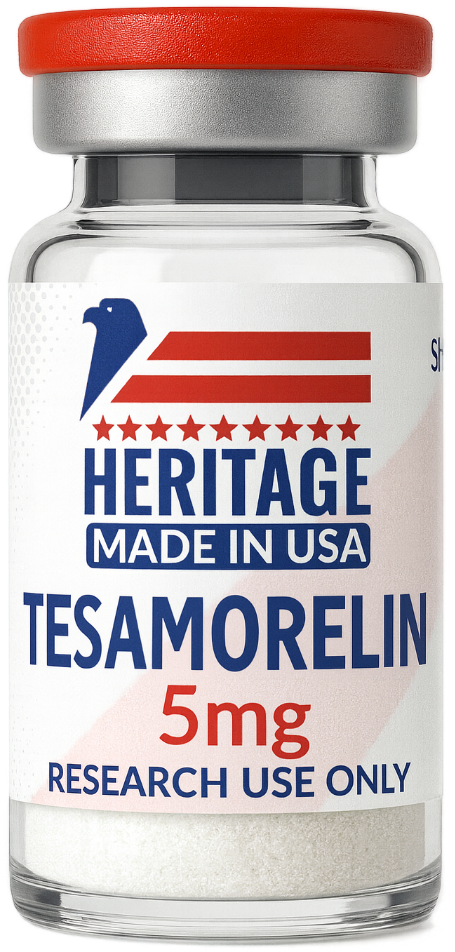
What is Tesamorelin?
Tesamorelin (brand name Egrifta) is your body's own GHRH sequence — all 44 amino acids — with one chemical tweak: a trans-3-hexenoic acid group attached to the first amino acid. That modification protects it from DPP-IV enzyme breakdown while keeping full receptor activity. Theratechnologies developed it, and it got FDA approval in 2010.
Tesamorelin stands alone as the only GHRH analog with actual regulatory approval. Its approved indication is the reduction of excess abdominal fat in HIV-infected patients with lipodystrophy, a condition where antiretroviral therapy causes pathological redistribution of body fat with accumulation of visceral adipose tissue. In two Phase 3 trials, Tesamorelin reduced trunk fat by 15–18% over 26 weeks while increasing IGF-1 levels and preserving subcutaneous fat and lean body mass.
It works by telling your pituitary to release growth hormone in natural pulses — not the flat, artificial GH profile you get from injecting recombinant GH. Your hypothalamic-pituitary feedback system stays intact. That means less risk of the problems that come with sustained GH elevation: insulin resistance, fluid retention, and the rest.
Mechanism of Action
Tesamorelin's mechanism centers on GHRH receptor activation with enhanced metabolic stability. Its structural modification provides a pharmacokinetic advantage over native GHRH and earlier analogs like Sermorelin.
Enhanced GHRH Receptor Binding
Tesamorelin retains the full 44-amino acid sequence of native GHRH, giving it complete receptor binding affinity. The trans-3-hexenoic acid modification at the N-terminus does not interfere with receptor interaction but provides critical protection against DPP-IV cleavage, the primary route of GHRH degradation in vivo. This results in a longer effective half-life and more sustained pituitary stimulation compared to unmodified GHRH [3].
Pulsatile GH Release & Feedback Preservation
Like native GHRH, Tesamorelin stimulates growth hormone release in a pulsatile pattern. Endogenous somatostatin continues to regulate pulse frequency, and GH/IGF-1 negative feedback remains operational. This is clinically significant because pulsatile GH secretion is required for optimal hepatic IGF-1 production and metabolic signaling. Studies have confirmed that Tesamorelin increases both GH pulse amplitude and mean 24-hour GH levels without disrupting pulse frequency [3].
Visceral Fat Reduction
The primary clinical effect of Tesamorelin is selective reduction of visceral adipose tissue (VAT). GH promotes lipolysis in visceral fat depots through hormone-sensitive lipase activation while simultaneously promoting fatty acid oxidation. Visceral adipocytes are particularly responsive to GH because they express higher densities of GH receptors compared to subcutaneous fat. In Phase 3 trials, Tesamorelin reduced VAT by 15–18% without significant changes in subcutaneous adipose tissue [1].
Metabolic Effects Beyond Fat Loss
Tesamorelin has shown improvements in lipid profiles, including reductions in triglycerides and increases in HDL cholesterol. It also reduces inflammatory biomarkers associated with visceral adiposity, including C-reactive protein. Emerging research suggests neuroprotective effects, with a clinical trial demonstrating improved cognitive function in older adults at risk for Alzheimer's disease [4].
Dosing Protocol
Tesamorelin dosing is well-established through FDA-approved clinical trials. The standard dose is 2 mg daily, which is the dose used in both Phase 3 pivotal trials.
| Protocol | Dose | Frequency | Duration | Notes |
|---|---|---|---|---|
| FDA-approved | 2 mg/day | Once daily SubQ | 26+ weeks | Abdominal injection, approved dose |
| Research standard | 1–2 mg/day | Once daily, pre-sleep | 12–26 weeks | Fasted state for optimal GH release |
| With Ipamorelin | 1 mg Tesa + 200 mcg Ipa | Once daily | 12–26 weeks | Synergistic GH pulse amplification |
- Inject on an empty stomach. Food, particularly carbohydrates and fats, blunts GH release through insulin elevation.
- Bedtime or pre-sleep dosing is preferred to align with the natural nocturnal GH surge.
- Clinical trials assessed efficacy at 26 weeks. Maximal visceral fat reduction may require 6+ months of consistent use.
- Fat regain has been observed after discontinuation in clinical trials, suggesting ongoing use may be needed to maintain results.
Reconstitution Guide
Reconstitute the Tesamorelin with bacteriostatic water. It dissolves easily. Don't shake.
- Remove the plastic cap from the Tesamorelin vial and wipe the rubber stopper with an alcohol swab. Allow to dry completely.
- Draw
2.5 mLof bacteriostatic water into a sterile syringe. For a 5 mg vial, this yields a concentration of2 mg/mL. - Insert the needle through the rubber stopper at a slight angle. Inject the water slowly against the inner wall of the vial — do not spray directly onto the peptide powder.
- Allow the vial to sit for 1–2 minutes. Gently roll the vial between your palms if needed. Do not shake or vortex.
- The solution should be completely clear and colorless. Discard if you observe any cloudiness, particulate matter, or discoloration.
5 mg vial + 2.5 mL BAC water: Concentration = 2 mg/mL
2 mg dose = 100 units (1 mL) on a 100-unit insulin syringe
1 mg dose = 50 units (0.5 mL) on a 100-unit insulin syringe
Doses per vial: 2.5 doses at 2 mg, or 5 doses at 1 mg
- 34 vials Tesamorelin (5 mg each) — provides 85 doses at 2 mg, covers 84 days
- 6 vials bacteriostatic water (30 mL each)
- 84 insulin syringes (29–31 gauge, 100-unit)
- Alcohol prep pads
Injection Technique
Tesamorelin is administered via subcutaneous injection into the abdomen. The abdominal injection site is standard for this compound based on its clinical trial protocol.
- Clean the injection site with an alcohol swab and allow it to air dry completely (approximately 30 seconds). Use the abdominal area, at least 2 inches from the navel. Avoid scar tissue or bruised areas.
- Draw the dose. Insert the needle into the vial through the rubber stopper. Invert the vial and draw the calculated number of units slowly. Tap the syringe to move any air bubbles to the top, then push them out gently.
- Pinch the skin at the injection site to create a fold of subcutaneous tissue. Insert the needle at a 45- to 90-degree angle in a quick, smooth motion. Release the skin fold.
- Inject slowly. Depress the plunger steadily over 5–10 seconds. Withdraw the needle at the same angle it was inserted. Apply gentle pressure with a clean swab if needed.
Rotate injection sites within the abdominal area to prevent lipodystrophy. Use a clock pattern around the navel, alternating between left and right sides daily. Allow at least 1 inch between consecutive injection sites. This is especially important with Tesamorelin given the larger injection volume (up to 1 mL).
Storage & Stability
Proper storage is essential for maintaining Tesamorelin potency. The compound is stable when stored correctly but should be protected from light and temperature extremes.
- Store vials upright, out of direct light. Store in the original box if possible.
- If you see condensation on a cold vial, let it warm to room temp before opening — moisture getting inside is bad news.
- Never re-freeze a reconstituted vial. If it sat out at room temp for more than 4 hours, toss it.
- Pro tip: label each vial with the reconstitution date so you know when your 28-day window closes.
Side Effects & Considerations
Tesamorelin's safety profile is well-documented through FDA-required clinical trials involving over 800 patients. Side effects are generally consistent with GH elevation.
Commonly Reported
- Injection site reactions — erythema, pruritus, pain, and urticaria. The most common adverse event, reported in approximately 13% of trial participants.
- Arthralgia (joint pain, ~13%) and myalgia (muscle pain) — consistent with GH-mediated effects on connective tissue and fluid balance.
- Peripheral edema and fluid retention — GH increases sodium reabsorption, leading to mild swelling in extremities.
- Paresthesia — tingling sensations, particularly in hands and fingers (carpal tunnel-like symptoms).
Metabolic Considerations
- May increase fasting glucose and HbA1c — GH is a counter-regulatory hormone that promotes hepatic glucose output. Pre-diabetic individuals should monitor blood glucose carefully.
- Elevated IGF-1 levels — periodic monitoring recommended, particularly during long-term use. IGF-1 typically normalizes after discontinuation.
- Contraindicated in active malignancy, as GH and IGF-1 may promote tumor growth.
- Contraindicated in pituitary disorders including pituitary surgery, irradiation, or hypophysitis.
Tesamorelin is FDA-approved for HIV-associated lipodystrophy. Use outside this indication is off-label. Everything here comes from published clinical and preclinical research and is not medical advice or a treatment recommendation.
Stacking Protocols
Tesamorelin can be combined with GHRPs for enhanced GH release, or used alongside other compounds targeting body composition.
Tesamorelin + Ipamorelin (GH Amplification Stack)
Combining a GHRH analog (Tesamorelin) with a GHRP (Ipamorelin) produces synergistic GH release exceeding either compound alone. The GHRH provides the "signal" while the GHRP amplifies the "response" through distinct receptor pathways on somatotroph cells.
| Peptide | Dose | Frequency | Duration |
|---|---|---|---|
| Tesamorelin | 1–2 mg | Once daily (pre-sleep) | 12–26 weeks |
| Ipamorelin | 200–300 mcg | With Tesamorelin | 12–26 weeks |
Lifestyle Factors
The following factors significantly influence Tesamorelin efficacy:
- Fasting state: Critical for Tesamorelin. Elevated insulin from recent meals suppresses GH release and will reduce the compound's effectiveness.
- Sleep quality: GH release peaks during deep sleep. Tesamorelin amplifies this natural pulse; poor sleep quality limits the response.
- Exercise: Resistance training and cardiovascular exercise independently reduce visceral fat and enhance GH sensitivity.
- Diet: Caloric management supports visceral fat reduction. High-glycemic diets promote visceral fat accumulation and may counteract Tesamorelin's effects.
Tesamorelin is available in 5 mg vials from Heritage Labs USA, a U.S.-based research peptide supplier with batch-level purity verification.
- Third-party purity testing (HPLC & MS)
- U.S.-based fulfillment
- Published COAs per lot
Literature & Citations
- Falutz J, Allas S, Blot K, et al. Metabolic effects of a growth hormone-releasing factor in patients with HIV. N Engl J Med. 2007;357(23):2359-2370. PubMed
- Falutz J, Potvin D, Mamputu JC, et al. Effects of tesamorelin (TH9507), a growth hormone-releasing factor analog, in human immunodeficiency virus-infected patients with excess abdominal fat. J Clin Endocrinol Metab. 2007;92(10):4005-4012. PubMed
- Stanley TL, Chen CY, Branch KL, et al. Effects of tesamorelin on endogenous GH pulsatility and insulin sensitivity. J Clin Endocrinol Metab. 2011;96(1):150-158. PubMed
- Dhillon S. Tesamorelin: a review of its use in the management of HIV-associated lipodystrophy. Drugs. 2011;71(8):1071-1091. PubMed
- Stanley TL, Fourman LT, Feldpausch MN, et al. Effects of tesamorelin on non-alcoholic fatty liver disease in HIV: a randomised, double-blind, multicentre trial. Lancet HIV. 2019;6(12):e821-e830. PubMed
- Baker LD, Barsness SM, Borber S, et al. Effects of growth hormone-releasing hormone on cognitive function in adults with mild cognitive impairment and healthy older adults. Arch Neurol. 2012;69(11):1420-1429. PubMed
- Mangili A, Falutz J, Grinspoon S, et al. Effects of tesamorelin on cardiovascular risk markers. J Acquir Immune Defic Syndr. 2015;68(3):295-300. PubMed