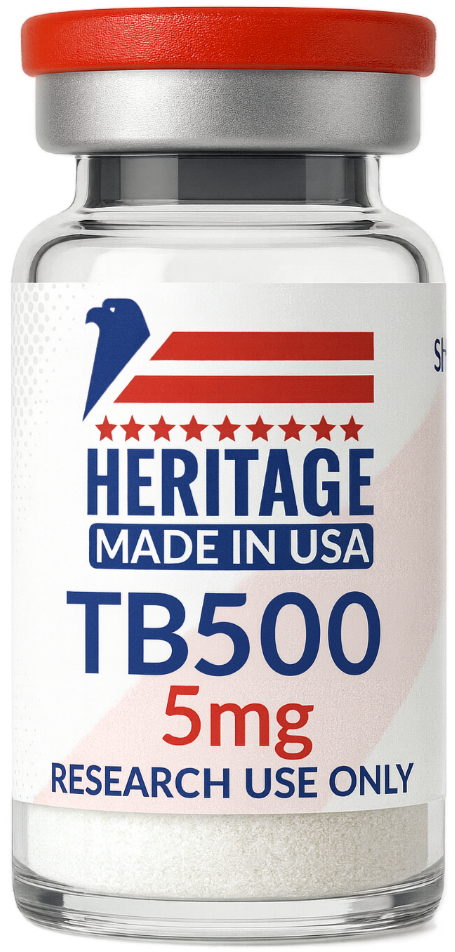
What is TB-500?
TB-500 is the synthetic version of Thymosin Beta-4, a 43-amino acid peptide that exists in virtually every cell in your body. Allan Goldstein first isolated it from the thymus gland in the 1960s. It's the most abundant beta-thymosin, and its job is straightforward: help cells move where they need to go, repair damaged tissue, and calm down inflammation.
TB-500's main trick is how it handles actin — the protein that forms your cells' internal scaffolding. It grabs G-actin monomers before they can polymerize too early, then releases them in a controlled way at the cell's leading edge. This is what allows cells to actually move. This process is essential for wound healing, as cells must migrate to the injury site, proliferate, and differentiate to repair damaged tissue. And here's the practical advantage: TB-500 works systemically. Inject it anywhere and it'll still reach the injury site through your bloodstream.
Research has shown TB-500's effects across multiple tissue types: cardiac muscle (improved survival after myocardial infarction in mice), corneal tissue (accelerated wound closure), dermal wounds (faster epithelialization), and musculoskeletal injuries (reduced inflammation and improved recovery in tendon and ligament damage). It also puts the brakes on inflammatory signaling (NF-kB) and promotes new blood vessel growth through VEGF, getting more blood flow to healing tissue.
Mechanism of Action
TB-500's therapeutic effects stem from multiple interconnected pathways centered on cytoskeletal regulation and immune modulation:
Actin Sequestration & Cell Migration
The central mechanism of TB-500 involves its binding to monomeric G-actin through the 17-amino acid actin-binding domain (residues 17–23, LKKTETQ). By sequestering G-actin, TB-500 prevents uncontrolled polymerization and enables directed actin filament assembly at the leading edge of migrating cells. This promotes rapid cell migration to injury sites — a critical rate-limiting step in wound healing [1].
Angiogenesis & Vascular Remodeling
TB-500 promotes the formation of new blood vessels through upregulation of VEGF (vascular endothelial growth factor) and direct stimulation of endothelial cell migration and tube formation. Research has shown that the actin-binding site itself is responsible for the angiogenic activity, as peptide fragments containing this domain retain the ability to stimulate new vessel growth [4].
Anti-Inflammatory Signaling
The peptide downregulates pro-inflammatory cytokines and chemokines, particularly through suppression of NF-kB signaling. In cardiac injury models, TB-500 administration reduced inflammatory cell infiltration and limited the expansion of the damage zone following ischemic events. This anti-inflammatory effect is systemic, contributing to the peptide's efficacy regardless of injection site [2].
Cardiac Protection & Repair
One of the most significant research findings involves TB-500's cardioprotective effects. In murine models of myocardial infarction, TB-500 activated Akt (protein kinase B), promoted cardiomyocyte survival, and stimulated the migration of cardiac progenitor cells to the injury zone. The integrin-linked kinase (ILK) pathway appears central to this effect, linking TB-500's cytoskeletal activity to cell survival signaling [2].
Dosing Protocol
TB-500 protocols typically involve a loading phase followed by a maintenance phase. The systemic nature of the peptide means injection location is less critical than with BPC-157.
| Phase | Dose | Frequency | Duration | Notes |
|---|---|---|---|---|
| Loading | 2–2.5 mg | Twice weekly | 4–6 weeks | Frontloads tissue saturation |
| Maintenance | 2 mg | Every 2 weeks | Ongoing | Sustains elevated levels after loading |
| Acute injury | 5 mg | Twice weekly | 2–3 weeks | Higher loading for acute injury response |
| With BPC-157 | 2 mg TB-500 + 250–500 mcg BPC-157 | Per standard schedule | 4–8 weeks | Commonly combined for synergistic repair |
- TB-500 works systemically — inject subcutaneously in any convenient location (abdomen is standard).
- Unlike BPC-157, proximity to the injury site is not required for efficacy.
- The loading phase is essential; maintenance-only dosing without prior loading may be insufficient for initial response.
- Inject on an empty stomach for optimal absorption.
Reconstitution Guide
Reconstitute the TB-500 with bacteriostatic water. Gently swirl the vial to dissolve; do not shake or vortex.
- Remove the plastic cap from the TB-500 vial and wipe the rubber stopper with an alcohol swab. Allow to dry.
- Draw
2 mLof bacteriostatic water into a sterile syringe. For a 5 mg vial, this yields a concentration of2,500 mcg/mL(2.5 mg/mL). - Insert the needle through the rubber stopper at a slight angle. Inject the water slowly against the inner wall of the vial — do not spray directly onto the peptide powder.
- Allow the vial to sit for 1–2 minutes. Gently roll the vial between your palms if needed. Do not shake or vortex.
- The solution should be completely clear and colorless. Discard if you observe any cloudiness, particulate matter, or discoloration.
5 mg vial + 2 mL BAC water: Concentration = 2,500 mcg/mL (2.5 mg/mL)
2 mg dose = 80 units (0.8 mL) on a 100-unit insulin syringe
2.5 mg dose = 100 units (1.0 mL / full syringe)
Doses per vial: 2 doses at 2.5 mg, or 2.5 doses at 2 mg
- 5 vials TB-500 (5 mg each) — provides 25 mg total, covers 12 doses of 2 mg with margin
- 2 vials bacteriostatic water (30 mL each)
- 12 insulin syringes (29–31 gauge, 100-unit)
- Alcohol prep pads
Injection Technique
TB-500 is administered via subcutaneous (SubQ) injection. Because TB-500 acts systemically, injection site proximity to the injury is not necessary.
- Clean the injection site with an alcohol swab and allow it to air dry completely (approximately 30 seconds). Common sites: lower abdomen (2 inches from the navel), upper thigh, or upper arm.
- Draw the dose. Insert the needle into the vial through the rubber stopper. Invert the vial and draw the calculated number of units slowly. Tap the syringe to move any air bubbles to the top, then push them out gently.
- Pinch the skin at the injection site to create a fold of subcutaneous tissue. Insert the needle at a 45- to 90-degree angle in a quick, smooth motion. Release the skin fold.
- Inject slowly. Depress the plunger steadily over 5–10 seconds. Withdraw the needle at the same angle it was inserted. Apply gentle pressure with a clean swab if needed.
Rotate your injection sites to prevent lipodystrophy (changes in the fat tissue under the skin). For belly injections, use a clock pattern around your navel. Note that TB-500 injection volumes are larger than most peptides (0.8–1.0 mL), so allow adequate spacing between sites. Keep at least 1 inch between sites.
Storage & Stability
TB-500 is moderately stable but less so than BPC-157. Timely use after reconstitution is important to maintain potency.
- Store vials upright, out of direct light.
- If you see condensation on a cold vial, let it warm to room temp before opening — moisture getting inside is bad news.
- Never re-freeze a reconstituted vial. If it sat out at room temp for more than 4 hours, toss it.
- Pro tip: write the reconstitution date on the vial so you know when the 21-day window expires.
Side Effects & Considerations
TB-500 has been generally well-tolerated in preclinical studies and early-phase clinical research.
Commonly Reported
- Temporary lethargy or tiredness — reported anecdotally during the loading phase, typically resolving within the first 1–2 weeks.
- Head rush or lightheadedness — occurring shortly after injection, uncommon and transient.
- Injection site redness or minor irritation — standard subcutaneous injection reaction.
Theoretical Considerations
- TB-500 promotes angiogenesis (new blood vessel formation). Individuals with active malignancies should exercise caution due to the potential for enhanced vascularization near tumors.
- Temporary hair growth has been reported anecdotally, consistent with Thymosin Beta-4's known role in hair follicle stem cell activation.
- The loading phase is important; initiating maintenance-only dosing without prior loading may yield insufficient tissue saturation for a meaningful response.
- No human clinical trials specifically for TB-500 have been completed. Safety data is derived from Thymosin Beta-4 research and preclinical models.
TB-500 is classified as a research peptide. It's not FDA-approved for clinical use. Everything here is from published preclinical research — not medical advice.
Stacking Protocols
TB-500 is most commonly combined with BPC-157 in recovery-focused research protocols. The two peptides are believed to work through complementary, non-overlapping mechanisms.
TB-500 + BPC-157 (Recovery Stack)
The most established combination in the research community. TB-500 works systemically to reduce inflammation and promote cell migration, while BPC-157 promotes localized tissue repair and angiogenesis at the injury site. The systemic + localized approach is believed to produce superior outcomes compared to either peptide alone.
| Peptide | Dose | Frequency | Duration |
|---|---|---|---|
| TB-500 | 2–2.5 mg | Twice weekly (loading) | 4–6 weeks |
| TB-500 (maintenance) | 2 mg | Every 2 weeks | Ongoing |
| BPC-157 | 250 mcg | Once daily (near injury) | 4–8 weeks |
Lifestyle Factors
These basics support what the peptides are trying to do:
- Sleep: Growth hormone release peaks during deep sleep. Prioritize 7–9 hours to maximize the body's natural repair window.
- Protein intake: Adequate amino acid availability supports the tissue remodeling that TB-500 initiates. Aim for 1.2–1.6 g/kg body weight.
- Hydration: Adequate fluid intake supports vascular function and nutrient transport to healing tissues.
- Low-impact movement: Gentle movement increases blood flow to healing areas without reinjury risk. Avoid high-intensity training on the target area during the recovery cycle.
TB-500 is available in 5 mg vials from Heritage Labs USA, a U.S.-based research peptide supplier with batch-level purity verification.
- Third-party purity testing (HPLC & MS)
- U.S.-based fulfillment
- Published COAs per lot
Literature & Citations
- Goldstein AL, Hannappel E, Kleinman HK. Thymosin beta4: actin-sequestering protein moonlights to repair injured tissues. Trends Mol Med. 2005;11(9):421-429. PubMed
- Bock-Marquette I, Saxena A, White MD, et al. Thymosin beta4 activates integrin-linked kinase and promotes cardiac cell migration, survival and cardiac repair. Nature. 2004;432(7016):466-472. PubMed
- Sosne G, Qiu P, Goldstein AL, Wheater M. Biological activities of thymosin beta4 defined by active sites in short peptide sequences. FASEB J. 2010;24(7):2144-2151. PubMed
- Philp D, Huff T, Gho YS, Hannappel E, Kleinman HK. The actin binding site on thymosin beta4 promotes angiogenesis. FASEB J. 2003;17(14):2103-2105. PubMed
- Malinda KM, Sidhu GS, Mani H, et al. Thymosin beta4 accelerates wound healing. J Invest Dermatol. 1999;113(3):364-368. PubMed
- Smart N, Risebro CA, Melville AA, et al. Thymosin beta4 induces adult epicardial progenitor mobilization and neovascularization. Nature. 2007;445(7124):177-182. PubMed
- Sosne G, Szliter EA, Barrett R, et al. Thymosin beta 4 promotes corneal wound healing and decreases inflammation in vivo following alkali injury. Exp Eye Res. 2002;74(2):293-299. PubMed