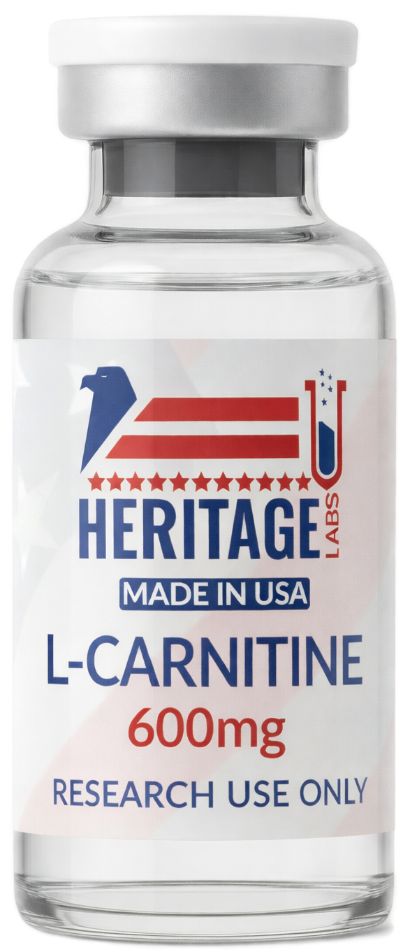
What is L-Carnitine?
L-Carnitine is a compound your body naturally makes from two amino acids (lysine and methionine) in the liver and kidneys. Its job is simple but critical: it ferries long-chain fatty acids across the inner mitochondrial membrane so they can be burned for energy. Without enough carnitine, those fatty acids can't get inside the mitochondria, and your body loses its ability to use stored fat as fuel.
Here's why the injectable form matters: you get 100% bioavailability versus a measly 14–18% with oral supplements. Injecting bypasses the gut entirely — no absorption bottlenecks, and you avoid the bacterial conversion to TMAO (a metabolite linked to cardiovascular risk) that happens when you take carnitine orally. This pharmacokinetic advantage has made injectable L-carnitine popular in clinical settings (FDA-approved as Carnitor for carnitine deficiency) and research applications focused on fat metabolism and exercise performance.
Beyond fatty acid transport, L-carnitine has been studied for exercise recovery, reduced muscle damage biomarkers (creatine kinase, lactate dehydrogenase), and cardiovascular function through improved myocardial energy metabolism. Your heart gets roughly 70% of its energy from burning fatty acids, which makes it especially dependent on having enough carnitine around. L-carnitine also supports electron transport chain function and helps remove toxic acyl-CoA metabolites from mitochondria via carnitine acyltransferases.
Mechanism of Action
L-Carnitine's primary function is as a biological shuttle, but its metabolic impact extends across multiple pathways within the mitochondrial energy production system.
CPT System & Fatty Acid Transport
Long-chain fatty acids (C14-C20) cannot cross the inner mitochondrial membrane independently. Carnitine palmitoyltransferase I (CPT-I) on the outer membrane converts fatty acyl-CoA to fatty acylcarnitine, which is transported across the membrane by carnitine-acylcarnitine translocase. CPT-II on the inner membrane reconverts the acylcarnitine back to acyl-CoA for beta-oxidation. This entire shuttle system depends on adequate carnitine availability [2].
Metabolic Waste Removal
Carnitine also serves a critical buffering function by accepting excess acyl groups that accumulate during periods of high metabolic flux (intense exercise, fasting). These acylcarnitines can be exported from the mitochondria and cell, preventing the toxic accumulation of acyl-CoA intermediates that inhibit key metabolic enzymes. This "metabolic buffering" role helps maintain the CoA/acyl-CoA ratio essential for TCA cycle function [1].
Exercise Recovery
Research has shown that L-carnitine supplementation reduces markers of exercise-induced muscle damage (creatine kinase, myoglobin, malondialdehyde) and accelerates recovery. The proposed mechanism involves improved blood flow to exercising muscle through enhanced nitric oxide production, reduced oxidative damage via antioxidant effects, and more efficient substrate utilization during recovery [3].
Cardiovascular Function
The myocardium has the highest carnitine concentration of any tissue, reflecting its dependence on fatty acid oxidation. L-carnitine supplementation has been studied in heart failure, angina, and post-MI recovery, with meta-analyses suggesting improvements in left ventricular ejection fraction and reductions in all-cause mortality in post-MI patients.
Dosing Protocol
Injectable L-carnitine dosing is well-established through both clinical use (FDA-approved for carnitine deficiency) and exercise science research.
| Protocol | Dose | Frequency | Duration | Notes |
|---|---|---|---|---|
| Fat metabolism | 200–600 mg | 3–5x per week | Ongoing | IM or SubQ, before exercise |
| Exercise performance | 500–1000 mg | Pre-workout | Ongoing | IM injection, 30–60 min prior |
| Clinical deficiency | 1000–3000 mg/day | IV or IM | As directed | FDA-approved indication (Carnitor) |
| Weight management | 600 mg | 3x per week | Ongoing | Often combined with diet and exercise program |
- For fat metabolism benefits, timing around exercise is optimal. Inject 30–60 minutes before training.
- L-carnitine is naturally occurring and does not require cycling. Continuous use is common.
- Injectable L-carnitine bypasses the gut microbiome conversion to TMAO that occurs with high-dose oral supplementation.
- Warming the solution to body temperature before IM injection significantly reduces injection site pain.
Administration Guide
Injectable L-carnitine comes as a ready-to-use sterile solution. No reconstitution is required.
600 mg vial (10 mL): Ready-to-use solution at 60 mg/mL.
200 mg dose = 3.3 mL via IM or SubQ injection
400 mg dose = 6.7 mL via IM injection (split across 2 sites for comfort)
600 mg dose = entire vial (10 mL) — IM injection, split across 2–3 sites
Doses per vial at 200 mg: 3 doses
- 4 vials L-Carnitine (600 mg / 10 mL each) — provides 12 doses, covers 4 weeks
- 12 syringes with 22–25 gauge needles (1–1.5 inch for IM)
- Alcohol prep pads
Injection Technique
L-Carnitine can be administered via intramuscular (IM) or subcutaneous (SubQ) injection. IM is preferred for larger volumes due to faster absorption and reduced site discomfort.
- Clean the injection site with an alcohol swab and allow it to air dry completely. For IM: deltoid, vastus lateralis (outer thigh), or dorsogluteal. For SubQ: abdomen or upper thigh.
- Draw the dose. Using a 22–25 gauge needle with a 3 mL or 5 mL syringe, draw the calculated volume from the multi-dose vial. Remove air bubbles by tapping and gently depressing the plunger.
- For IM injection: Insert the needle at a 90-degree angle into the muscle. Do not pinch the skin for IM injections. For SubQ: pinch a skin fold and insert at 45 degrees.
- Inject at a moderate pace. For larger volumes (3+ mL), inject over 15–20 seconds. Withdraw the needle and apply pressure with a clean swab. Massage the IM site gently to aid dispersion.
L-carnitine IM injections can be uncomfortable, especially at higher volumes. Warm the vial to body temperature by holding it in your hand for 2–3 minutes before drawing. For doses above 3 mL, split across two injection sites. Rotate between deltoid, thigh, and gluteal sites. Using a 25-gauge needle reduces pain compared to 22-gauge, though the injection is slower.
Storage & Stability
L-Carnitine solution is stable at a wider temperature range than most peptides, reflecting the compound's inherent chemical stability.
- L-Carnitine solution does not require refrigeration but refrigeration is acceptable.
- Protect from direct sunlight and extreme heat.
- Multi-dose vials should be discarded 28 days after the first puncture to maintain sterility.
- Always use a new, sterile needle when drawing from the multi-dose vial.
Side Effects & Considerations
L-Carnitine has an excellent safety profile with decades of clinical use. It is FDA-approved as Carnitor for carnitine deficiency, providing extensive human safety data.
Commonly Reported
- Injection site pain — especially with IM administration. Warming the solution and using a smaller gauge needle helps. Usually mild and brief.
- Body odor at high doses — L-carnitine is metabolized to trimethylamine, which has a fishy odor. More common at oral doses above 3 g/day; less frequent with injectable due to lower doses and bypassed gut metabolism.
Less Common
- Mild GI discomfort — rare with injectable route (more common with oral supplementation).
- Nausea at very high IV doses — typically only in clinical carnitine deficiency treatment settings.
- Contraindicated in seizure disorders at high doses — L-carnitine has been associated with lowered seizure threshold in some susceptible individuals.
Injectable L-carnitine (Carnitor) is FDA-approved for carnitine deficiency. Use for fat metabolism and exercise performance is well-supported by peer-reviewed research but represents off-label application. L-carnitine is naturally produced by the body and present in dietary meat sources.
Stacking Protocols
L-Carnitine is commonly combined with other compounds targeting fat metabolism and exercise performance. Its role as a fatty acid transporter makes it complementary to agents that increase lipolysis.
L-Carnitine + LIPO-C (Metabolic Support Stack)
L-Carnitine handles fatty acid transport into mitochondria while the MIC+B12 components of LIPO-C support hepatic fat processing and methylation. This combination targets fat metabolism from both the cellular transport and liver processing angles.
| Compound | Dose | Frequency | Duration |
|---|---|---|---|
| L-Carnitine | 200–600 mg IM | 3x per week | Ongoing |
| LIPO-C | 1 mL IM | 1–2x per week | Ongoing |
Lifestyle Factors
L-Carnitine's fat metabolism benefits are maximized with complementary lifestyle practices:
- Exercise timing: Inject 30–60 minutes before cardiovascular exercise for maximal fatty acid oxidation during the workout.
- Fasted training: Training in a fasted or low-insulin state increases fatty acid mobilization from adipose tissue, giving L-carnitine more substrate to transport.
- Adequate protein: L-carnitine is synthesized from lysine and methionine. Protein-deficient diets can reduce endogenous carnitine production.
- Caloric deficit: L-carnitine enhances fat oxidation but does not create a caloric deficit on its own. It is most effective as part of a structured nutrition plan.
Injectable L-Carnitine is available in 600 mg / 10 mL vials from Heritage Labs USA, a U.S.-based research supplier with batch-level purity verification.
- Third-party purity testing (HPLC & MS)
- U.S.-based fulfillment
- Published COAs per lot
Literature & Citations
- Fielding R, Riede L, Luber JP, Clevidence BA. L-Carnitine Supplementation in Recovery after Exercise. Nutrients. 2018;10(3):349. PubMed
- Pekala J, Patkowska-Sokola B, Bodkowski R, et al. L-carnitine — metabolic functions and meaning in humans life. Curr Drug Metab. 2011;12(7):667-678. PubMed
- Volek JS, Kraemer WJ, Rubin MR, et al. L-Carnitine L-tartrate supplementation favorably affects markers of recovery from exercise stress. Am J Physiol Endocrinol Metab. 2002;282(2):E474-E482. PubMed
- Wall BT, Stephens FB, Constantin-Teodosiu D, et al. Chronic oral ingestion of L-carnitine and carbohydrate increases muscle carnitine content and alters muscle fuel metabolism during exercise in humans. J Physiol. 2011;589(Pt 4):963-973. PubMed
- Brass EP. Supplemental carnitine and exercise. Am J Clin Nutr. 2000;72(2 Suppl):618S-623S. PubMed
- DiNicolantonio JJ, Lavie CJ, Fares H, et al. L-Carnitine in the secondary prevention of cardiovascular disease: systematic review and meta-analysis. Mayo Clin Proc. 2013;88(6):544-551. PubMed