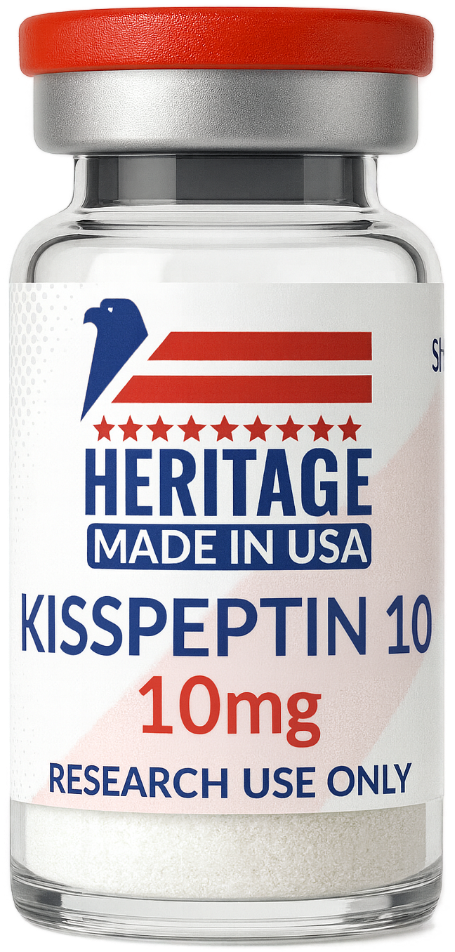
What is Kisspeptin-10?
Kisspeptin-10 is the stripped-down, active core of a larger 54-amino acid neuropeptide called kisspeptin — just the last 10 amino acids, which is all you need for receptor activation. Kisspeptins are encoded by the KISS1 gene and bind to the G protein-coupled receptor GPR54 (also called KISS1R). The kisspeptin system became famous in 2003 when researchers discovered that people with broken GPR54 receptors couldn't go through puberty properly — they had hypogonadotropic hypogonadism [3].
Kisspeptin neurons in the hypothalamus directly stimulate GnRH (gonadotropin-releasing hormone) neurons, triggering pulsatile GnRH secretion, which in turn drives LH and FSH release from the anterior pituitary. That makes kisspeptin the master switch sitting at the very top of your reproductive hormone cascade. In clinical studies, a single intravenous bolus of kisspeptin-10 in healthy men produced robust, dose-dependent increases in LH, FSH, and testosterone, with LH peaks occurring within 30–40 minutes [1].
The research goes well beyond basic reproductive biology. It has been studied in the context of IVF (as a safer alternative to hCG for triggering oocyte maturation, avoiding ovarian hyperstimulation syndrome) [4], hypothalamic amenorrhea, hypogonadism, and as a potential diagnostic tool for evaluating GnRH neuron function. The kisspeptin system also integrates metabolic signals, linking nutritional status to reproductive capacity.
Mechanism of Action
Kisspeptin-10 acts as the master upstream trigger of the hypothalamic-pituitary-gonadal (HPG) axis through a well-characterized signaling cascade:
GPR54 Receptor Activation
Kisspeptin-10 binds to GPR54 (KISS1R), a Gαq/11-coupled receptor expressed on GnRH neurons in the hypothalamus. Receptor activation triggers phospholipase C (PLC) signaling, leading to IP3-mediated calcium release and PKC activation. This depolarizes GnRH neurons and triggers GnRH pulse generation. The 10-amino acid C-terminal fragment retains full receptor binding affinity, making it equipotent to the full-length 54-amino acid form [3].
GnRH Pulse Generation
Kisspeptin neurons in the arcuate nucleus of the hypothalamus form the GnRH pulse generator. These neurons co-express neurokinin B and dynorphin (KNDy neurons) and synchronize to produce pulsatile kisspeptin release, which drives pulsatile GnRH secretion. Exogenous kisspeptin-10 mimics this pulse, stimulating a burst of GnRH that in turn triggers LH and FSH release from anterior pituitary gonadotropes [2].
LH/FSH & Testosterone Cascade
Following kisspeptin-10 administration, the hormonal cascade unfolds rapidly: LH peaks within 30–40 minutes, FSH rises more gradually, and testosterone increases within 60–90 minutes in males. The LH response is dose-dependent and robust, with increases of 3–8 fold above baseline reported in healthy male subjects. This represents the most upstream pharmacological intervention possible in the HPG axis [1].
Desensitization & Pulsatility
A critical consideration with kisspeptin is that continuous administration leads to GnRH neuron desensitization and paradoxical LH suppression. Pulsatile administration (mimicking the natural episodic release pattern) preserves the LH response, while continuous infusion causes tachyphylaxis within hours [2]. This desensitization mechanism has implications for both research dosing strategies and potential therapeutic applications.
Dosing Protocol
Kisspeptin-10 dosing is based on clinical study data. The critical consideration is pulsatile versus continuous administration — pulsatile preserves efficacy, continuous causes desensitization.
| Protocol | Dose | Frequency | Duration | Notes |
|---|---|---|---|---|
| Acute LH stimulation | 1–10 mcg/kg IV | Single bolus | One-time | Clinical study paradigm |
| SubQ research | 100–500 mcg | 1–2x daily | Variable | Subcutaneous dosing, pulsatile pattern |
| Pulsatile protocol | 100 mcg | Every 90 minutes | Research only | Mimics natural GnRH pulsatility |
| Conservative SubQ | 100 mcg | Once daily | 2–4 weeks | Minimum effective single-pulse dose |
- Pulsatile dosing is critical. Continuous administration leads to receptor desensitization and paradoxical LH suppression. Space doses at least 90 minutes apart if using multiple daily doses.
- The LH response peaks within 30–40 minutes of administration and returns to baseline within 2–4 hours.
- Morning dosing may align with the natural circadian peak of testosterone production.
- Not recommended for individuals with hormone-sensitive conditions without medical supervision.
Reconstitution Guide
Reconstitute the Kisspeptin-10 with bacteriostatic water. Kisspeptin fragments can degrade; maintain strict cold chain and use promptly.
- Remove the plastic cap from the Kisspeptin-10 vial and wipe the rubber stopper with an alcohol swab. Allow to dry.
- Draw
2 mLof bacteriostatic water into a sterile syringe. For a 10 mg vial, this yields a concentration of5,000 mcg/mL. - Insert the needle through the rubber stopper at a slight angle. Inject the water slowly against the inner wall of the vial — do not spray directly onto the peptide powder.
- Allow the vial to sit for 1–2 minutes. Gently roll the vial between your palms if needed. Do not shake or vortex.
- The solution should be completely clear and colorless. Discard if you observe any cloudiness, particulate matter, or discoloration.
10 mg vial + 2 mL BAC water: Concentration = 5,000 mcg/mL
100 mcg dose = 2 units (0.02 mL) on a 100-unit insulin syringe
250 mcg dose = 5 units (0.05 mL) on a 100-unit insulin syringe
Doses per vial: 100 doses at 100 mcg, or 40 doses at 250 mcg
- 1 vial Kisspeptin-10 (10 mg) — provides 40 doses at 250 mcg, covers 28 days with margin
- 1 vial bacteriostatic water (30 mL)
- 28 insulin syringes (29–31 gauge, 0.3 mL for accuracy with small volumes)
- Alcohol prep pads
Injection Technique
Kisspeptin-10 is administered via subcutaneous (SubQ) injection. Small injection volumes require a 0.3 mL or 0.5 mL insulin syringe for accurate dosing.
- Clean the injection site with an alcohol swab and allow it to air dry completely (approximately 30 seconds). Common sites: lower abdomen (2 inches from the navel), upper thigh, or upper outer arm.
- Draw the dose. Insert the needle into the vial through the rubber stopper. Invert the vial and draw the calculated number of units slowly. Tap the syringe to move any air bubbles to the top, then push them out gently.
- Pinch the skin at the injection site to create a fold of subcutaneous tissue. Insert the needle at a 45- to 90-degree angle in a quick, smooth motion. Release the skin fold.
- Inject slowly. Depress the plunger steadily over 5–10 seconds. Withdraw the needle at the same angle it was inserted. Apply gentle pressure with a clean swab if needed.
Rotate sites to prevent lipodystrophy. For belly injections, work around the navel in a clock pattern. Keep at least 1 inch between sites.
Storage & Stability
Kisspeptin-10 fragments can degrade; strict cold chain maintenance is essential for potency preservation.
- Store vials upright, out of direct light.
- If you see condensation on a cold vial, let it warm to room temp before opening — moisture getting inside is bad news.
- Never re-freeze once reconstituted. If it spent more than 2 hours at room temp, throw it away.
- Label reconstituted vials with the date to track the 14-day use window.
Side Effects & Considerations
Kisspeptin-10 has been studied in multiple clinical trials with generally well-tolerated safety profiles at tested doses.
Commonly Reported
- Facial flushing and warmth — common and transient, resulting from vasodilatory effects. Typically resolves within 30 minutes.
- Headache — reported in clinical studies, usually mild.
- Abdominal discomfort — mild and infrequent.
Theoretical Considerations
- Continuous administration causes desensitization. Prolonged or continuous kisspeptin exposure leads to GnRH neuron tachyphylaxis and paradoxical LH suppression. Pulsatile dosing is essential.
- Significant hormonal effects (LH, FSH, testosterone) require careful consideration in individuals with hormone-sensitive conditions.
- Effects on female reproductive physiology differ from male; sexual dimorphism in response has been documented [2].
- The kisspeptin system integrates metabolic signals; response may vary with nutritional status and body composition.
Kisspeptin-10 is a research peptide. It's not FDA-approved for any clinical indication, though clinical trials are ongoing for IVF and hypogonadism applications. Everything here comes from published research and is not medical advice or a treatment recommendation.
Stacking Protocols
Kisspeptin-10 occupies a unique position as the most upstream regulator of the HPG axis. Stacking considerations should account for its potent hormonal effects.
Lifestyle Factors
Research suggests the following practices may support optimal HPG axis function alongside kisspeptin-10:
- Sleep: Testosterone production peaks during sleep, with the highest levels during REM cycles. 7–9 hours of quality sleep maximizes the hormonal response to kisspeptin-10.
- Resistance training: Compound exercises (squats, deadlifts, bench press) independently stimulate testosterone production. Combined with kisspeptin-10's LH stimulation, this may produce additive effects.
- Body composition: Excess adipose tissue increases aromatase activity, converting testosterone to estradiol. Maintaining healthy body composition supports the downstream hormonal effects of kisspeptin-10.
- Stress management: Chronic cortisol elevation suppresses the HPG axis through hypothalamic inhibition. Stress reduction practices support the hormonal cascade that kisspeptin-10 initiates.
- Zinc and vitamin D: Both are essential for testosterone biosynthesis and support the downstream effects of LH stimulation.
Kisspeptin-10 is available in 10 mg vials from Heritage Labs USA, a U.S.-based research peptide supplier with batch-level purity verification.
- Third-party purity testing (HPLC & MS)
- U.S.-based fulfillment
- Published COAs per lot
Literature & Citations
- Dhillo WS, Chaudhri OB, Patterson M, et al. Kisspeptin-54 stimulates the hypothalamic-pituitary gonadal axis in human males. J Clin Endocrinol Metab. 2005;90(12):6609-6615. PubMed
- Jayasena CN, Nijher GM, Comninos AN, et al. The effects of kisspeptin-10 on reproductive hormone release show sexual dimorphism in humans. J Clin Endocrinol Metab. 2011;96(12):E1963-E1972. PubMed
- Seminara SB, Messager S, Chatzidaki EE, et al. The GPR54 gene as a regulator of puberty. N Engl J Med. 2003;349(17):1614-1627. PubMed
- Abbara A, Jayasena CN, Christopoulos G, et al. Efficacy of Kisspeptin-54 to Trigger Oocyte Maturation in Women at High Risk of Ovarian Hyperstimulation Syndrome. J Clin Endocrinol Metab. 2015;100(9):3322-3331. PubMed
- Topaloglu AK, Reimann F, Guclu M, et al. TAC3 and TACR3 mutations in familial hypogonadotropic hypogonadism reveal a key role for Neurokinin B in the central control of reproduction. Nat Genet. 2009;41(3):354-358. PubMed
- George JT, Veldhuis JD, Roseweir AK, et al. Kisspeptin-10 is a potent stimulator of LH and increases pulse frequency in men. J Clin Endocrinol Metab. 2011;96(8):E1228-E1236. PubMed
- Jayasena CN, Abbara A, Veldhuis JD, et al. Increasing LH pulsatility in women with hypothalamic amenorrhoea using intravenous infusion of Kisspeptin-54. J Clin Endocrinol Metab. 2014;99(6):E953-E961. PubMed